Not Every Product Is Strategic – But Every Product Needs a Price
Learn how to distinguish strategic from non-strategic products, focus pricing efforts where they matter most, and use automation to boost profitability.
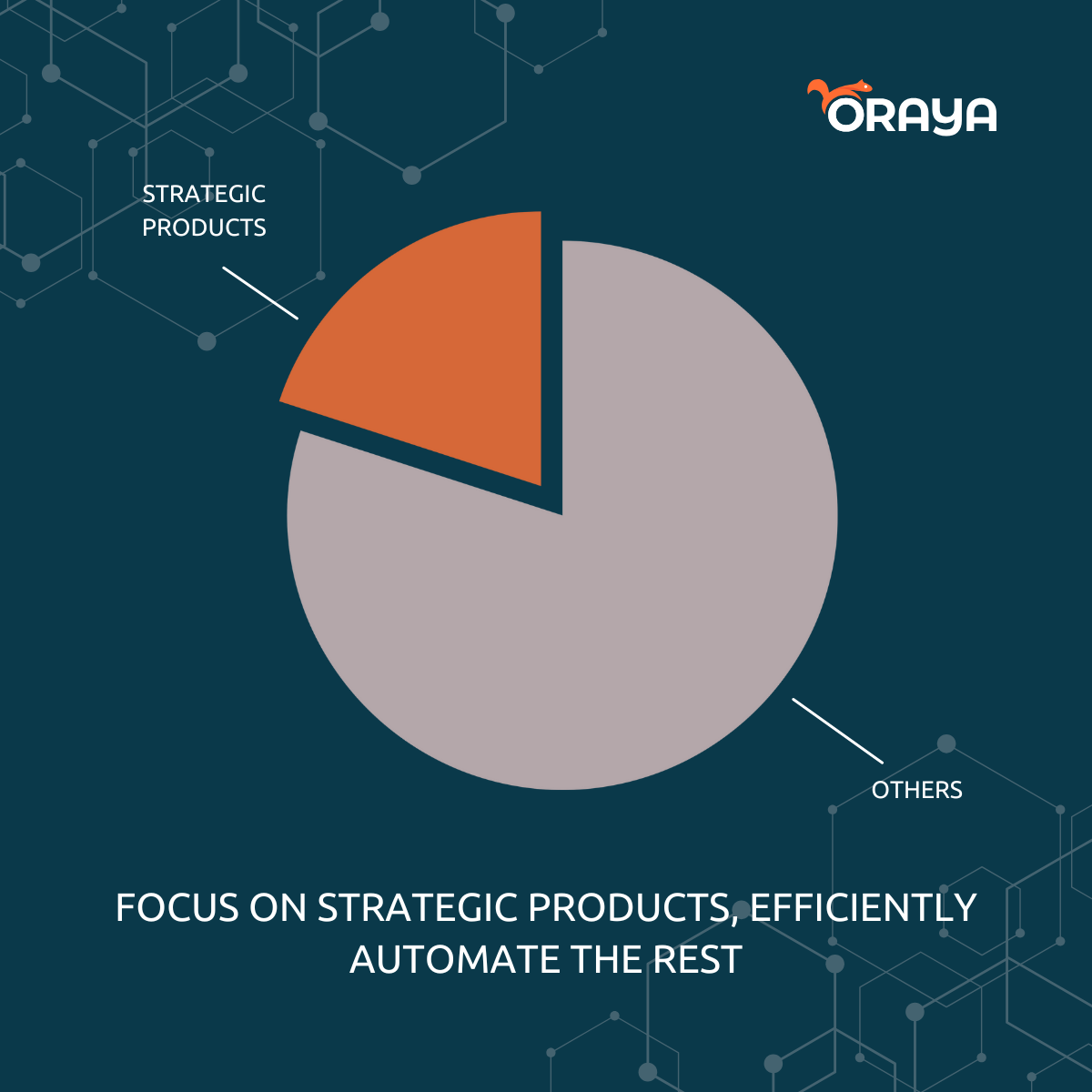
A common challenge: Many companies apply the same pricing methods to their entire product portfolio. But not every product plays the same role in the market. A TV in a consumer electronics store has a far bigger impact on market perception than an HDMI cable.
The critical question is: Which products deserve an in-depth, strategic pricing approach – and where will a consistent, rule-based model do the job?
1. Strategic vs. Non-Strategic Products
What makes a product “strategic”? A product is strategic if it has an outsized influence on a company’s market position, price perception, or profitability. This can happen in several ways:
- Price signal products: Highly visible items whose prices competitors and customers watch closely (e.g., TVs, smartphones).
- Revenue drivers: Products that generate a disproportionate share of sales or profit.
- Bundling products: Items that lead to repeat purchases or follow-on sales (e.g., razors and blades, printers and ink).
- Image products: Flagship items that define brand perception (e.g., premium car models).
Non-strategic products tend to be more interchangeable, complementary, or primarily logistical in nature.
The trap: Many businesses devote the same time and resources to pricing every SKU – which dilutes focus and wastes effort.
2. Why the Distinction Matters
Strategic products require deep, data-driven pricing – incorporating market intelligence, competitor tracking, elasticity modeling, and value-based approaches.
Non-strategic products are better served by efficient, automated pricing rules – margin bands, price clustering, or dynamic adjustments based on simple triggers.
The payoff: You concentrate your pricing resources where they deliver a real competitive edge.
3. Core Concepts: Price Bundling & Contribution Margin
Price bundling: Seeing the bigger picture Many companies use cross-subsidization – selling low-margin “traffic drivers” alongside high-margin items. Example: A retailer sells a gaming console at a razor-thin margin but earns healthy profit on accessories and service plans.
Contribution margin: The essential profitability lens Contribution margin (CM) reveals how much profit a product generates after covering variable costs:
CM = Selling price – Variable costs
- CM I shows whether a product covers its variable costs.
- CM II/III (with allocated fixed costs) offer deeper insight into true profitability.
Why it matters for pricing:
- High-CM products can be priced more aggressively if strategically important.
- Low-CM products need clear price floors and tighter controls.
4. Cost-Based Pricing: The Traditional Approach
The simplest method is full cost plus a mark-up:
Example: Variable costs: €50 Fixed cost allocation: €30 Profit margin: 20% of total cost (€16)
Selling price = €50 + €30 + €16 = €96
Pros:
- Easy to calculate and explain.
- Works well in stable, low-competition markets.
Cons:
- Ignores willingness to pay and market positioning.
- Doesn’t reflect competitive dynamics.
Modern pricing teams therefore blend cost-based, competition-based, and value-based methods for a more complete approach.
5. A Framework for Spotting Strategic Products
Key questions to ask:
- Market visibility: Is the price highly transparent to customers and competitors?
- Profit contribution: How much does it drive margin?
- Bundling effects: Does it trigger follow-up or cross-sales?
- Brand impact: Does it shape brand perception?
Pro tip: An ABC-XYZ analysis combines revenue share (ABC) with demand predictability (XYZ) to systematically segment products.
6. Where Automation Creates the Edge
Pricing thousands of products manually is slow, costly, and error-prone. With a solution like rupio, you can:
- Define rule-based pricing logic (margin corridors, price thresholds).
- Automatically protect contribution margin targets.
- Fine-tune price signals for competitive impact.
The result: Your team spends less time on routine adjustments and more on high-impact strategic pricing.
Conclusion
Strategic pricing isn’t about making every decision by hand – it’s about knowing where your effort moves the needle. By combining classic costing methods, contribution margin management, and smart automation, you can stay competitive in dynamic markets.
👉 Want to take your pricing strategy to the next level? With rupio, you can manage price bundling, contribution margins, and competitive price signals transparently and automatically – freeing you up to focus on the pricing decisions that truly matter.